Compound Interest Calculator
Watch your money snowball
Use this simple calculator to see how your savings and investments can grow over time with the power of compound interest.
Our compound interest calculator is designed to help you visualise how your savings or investments could grow over time, whether you contribute regularly or not. By showing how compound interest amplifies returns, our tool can demonstrate how even small investments now can influence your financial future. Curious about making the most of your returns?
Scroll down to explore how compound interest works and how to make the most of it. You can even experiment with different contribution scenarios to see how much you stand to gain. Start planning today!
How to leverage compound interest for growth
How compound interest could work for you
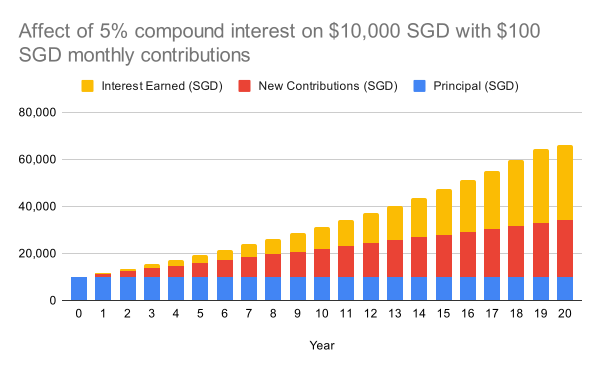
Let's say you invest $10,000 SGD at a fixed 5% yearly interest rate, compounded yearly, and with a monthly contribution of $100 SGD for 20 years.
Your money will grow to $66,212.12 SGD. This means a total interest of $32,212.12 SGD and a return on investment of 94%.
Please note that these calculations use a fixed annual interest rate for illustration. Actual investment returns can vary due to:
- Market fluctuations
- Changing interest rates
- Inflation
- Economic conditions
If you’re investing rather than saving at a fixed rate, your actual returns may differ from the example.
Top investment options to leverage compound interest
Compound interest is often hailed as the "eighth wonder of the world" for its ability to grow wealth over time significantly. Whether you’re new to investing or a seasoned investor, understanding where to invest for compound interest is crucial to building long-term financial success. But how do you choose the right vehicle to make the most of compounding? Here are some of the top choices:
Our investment solutions
General Investing
Most popular
powered by StashAway

Precise control with 12 risk levels

Designed to keep risk constant

Built for long-term wealth creation
Performance:
1 year returns 6.4% - 26.6%
ETF Explorer
Most popular

Select from over 80+ asset classes

Customisable
Free buy orders with SRS funds until 31 January 2026
Performance:
Customisable
Income Investing
powered by J.P. Morgan Asset Management

Aimed at capital preservation and payouts

Diversified bond exposures

Investment-grade credit quality
Performance:
4.8% p.a.
Singapore Investing
Performance:
10.3% p.a.
Simple™ Cash
Ultra-low risk
No minimum balance
Optimised for cash growth
Performance:
Returns from 2.5% to 4% p.a.
Build your wealth today
Start investing from as little as you want.

Download our mobile app




Frequently Asked Questions
What is compound interest and how does it work?
Compound interest is interest earned on both your original amount and the interest it has already generated. Over time, this “interest on interest” effect accelerates your overall growth.
What’s the difference between simple interest and compound interest?
Simple interest based solely on the principal, compound interest magnifies your returns, especially when combined with regular investments over time. This powerful strategy can significantly accelerate the growth of your savings or investments, maximising long-term wealth potential.
Example: An initial $10,000 investment at a 5% annual rate over 20 years clearly shows how compound interest outpaces simple interest and no-interest scenarios.
After 20 years, an initial $10,000 investment with no compounding (simple interest) would grow to $20,000, while the same investment with compound interest would increase to $26,532.98!

How often is interest compounded?
Interest is compounded depending on the investment and account. A higher compounding frequency typically results in slightly higher returns.
With this calculator, you can choose the compounding frequency:
- Daily
- Weekly
- Monthly
- Quarterly
- Yearly
Does compounding monthly vs annually make a big difference?
Compounding monthly instead of annually does increase your total returns, but the difference is usually modest in the short term. Over longer periods—10 years or more—monthly compounding can produce noticeably higher growth because interest is added more frequently. The higher the interest rate and the longer the time horizon, the bigger the difference becomes.
How do contributions affect my compound interest results?
While compound interest alone can significantly boost your savings, consistent contributions can supercharge your growth. In the example above, starting with $10,000 at a 5% annual yield, compounded yearly over 20 years, yields $16,523.98 in interest.
However, by contributing an additional $100 at the end of each month, you would earn a total of $32,212.12 in interest from a total deposit of $34,000 ($10,000 principal + $24,000 contributions). This demonstrates how the combination of compounding and regular contributions work together to build long-term wealth

How can I increase my total compound interest earned?
You can maximise your compound interest by taking steps that help your money grow for longer and at higher rates. The most effective strategies include:
- Contributing regularly: frequent deposits give your balance more opportunities to compound.
- Starting earlier: the longer your money stays invested, the faster compounding accelerates.
- Increasing your contribution amount: a larger base leads to larger compounded returns.
- Choosing higher long-term return options: accounts or investments with better expected returns compound more effectively over time.
Can I use this calculator for SRS, CPF, or savings accounts?
Yes. Simply input the relevant interest rate (or return rate) and your planned contributions. The calculator will estimate future value based on compounding.
You can also visit our SRS calculator, fixed deposit calculator and salary calculator for more specific functions.
What time horizon should I choose for realistic projections?
Your time horizon should reflect the financial goal you’re planning for. Short-term goals—like a holiday, a home deposit, or an emergency fund—usually involve a 1–5 year horizon, where returns tend to be smaller and more predictable. Medium-term goals, such as education planning or major purchases, often require 5–10 years to see meaningful compounding.
For long-term goals like retirement or building wealth, a 10–30 year horizon provides the most realistic projection because compounding accelerates significantly over extended periods. In general, the longer your time horizon, the more accurate and meaningful your projections will be, since short-term market movements have less impact on long-term trends.
If you’re unsure, choose the longest timeline relevant to your goal—this gives you a clearer picture of your potential growth and helps set more achievable expectations.